

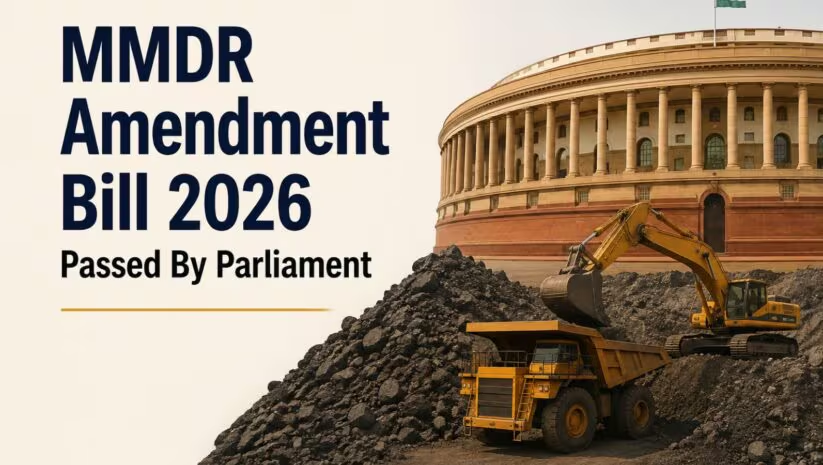
In a major legislative milestone strengthening national energy security and critical mineral supply chains, Parliament officially concluded its 2026 Monsoon Session sine die after passing 12 key bills, anchored by the final passage of the landmark Mines and Minerals (Development and Regulation) Amendment Bill, 2026.
As detailed in parliamentary coverage published by The Hindu and official broadcast reports from News On AIR, the bill cleared the Upper House (Rajya Sabha) following its passage in the Lower House (Lok Sabha) a day earlier, finalizing the legislative process ahead of Presidential assent.
Key Takeaways from the Mines & Minerals Amendment Bill 2026
- Standardizing National Mineral Royalties: Restricts regional state-level double-taxation on mineral-bearing lands, establishing a uniform national royalty ceiling.
- Accelerating Private Sector Exploration: Streamlines exploration licenses (EL) for critical green energy minerals including lithium, cobalt, nickel, graphite, and rare earth elements.
- Boosting EV & High-Tech Manufacturing: Ensures domestic supply chain resilience for electric vehicle battery gigafactories and semiconductor fabrication plants.
- Monsoon Session Concludes Sine Die: Concludes a high-intensity parliamentary session that passed 12 major economic and administrative reform bills.
Deep Dive: Why Critical Mineral Reform Is Pivotal for Energy Security
As global manufacturing shifts toward renewable energy storage, electric mobility, and advanced electronics, access to critical minerals has become a primary pillar of national economic security. Historically, complex multi-tier licensing processes and overlapping state-level taxes created lengthy administrative delays, discouraging private mining exploration firms from investing in deep-seated mineral deposits.
The Mines and Minerals Amendment Bill 2026 directly addresses these statutory bottlenecks. By granting statutory clarity under the Ministry of Mines, the new law establishes competitive auction mechanisms for exploration blocks, incentivizing private junior exploration companies to deploy advanced geophysical survey technologies across untapped geological regions.
“Securing domestic access to critical minerals is not merely an industrial objective—it is a fundamental requirement for 21st-century technological sovereignty. The passage of the Mines and Minerals Amendment Bill 2026 establishes the regulatory predictability required to attract world-class mining exploration capital.”
National Critical Minerals Legislative Frameworks Comparison Matrix
| Nation & Legislative Framework | Private Exploration Licensing Model | Tax & Royalty Standardization | Primary Strategic Supply Chain Focus |
|---|---|---|---|
| India (Mines & Minerals Bill 2026) | Competitive Auctioned Exploration Licenses | Uniform Federal Royalty Ceiling | Lithium, cobalt, nickel, graphite, & rare earth element domestic processing. |
| United States (Critical Minerals Security Act) | Federal Fast-Track Permitting & Clean Energy Grants | Federal Inflation Reduction Act Tax Credits | Domestic battery manufacturing, defense electronics, & permanent magnets. |
| European Union (Critical Raw Materials Act) | Strategic Project Designation Framework | Member State Tax Incentives & Subsidies | Reducing import reliance on external battery metal refiners by 2030. |
| Australia (Critical Minerals Strategy) | Junior Exploration Target Grants & Co-Funding | State-Level Resource Rent Royalty Offsets | Expanding high-purity lithium, nickel, & manganese export refining. |
Video Briefing & Parliamentary Politics Analysis
Video Briefing: Parliamentary Legislation & Critical Mineral Politics
Watch broadcast political analysis on the conclusion of the Parliamentary Monsoon Session and legislative reforms:
▶ Watch Video: Parliamentary Politics & Economic Reform Review
The Political Debate: Federal Coordination vs. State Royalty Revenues
The passage of the bill sparked intense parliamentary debate regarding fiscal federalism and state revenue rights:
- Federal Economic Rationale: Parliamentary advocates emphasized that unpredictable state-level mineral levies created internal trade barriers, discouraging international mining conglomerates from bidding on domestic blocks.
- State Revenue Concerns: Opposition lawmakers argued that restricting state taxation powers on mineral-bearing lands infringes on regional fiscal autonomy, urging higher profit-sharing mechanisms for local mining communities.
- Environmental & Tribal Protections: Environmental groups noted that streamlined exploration permits must strictly preserve local Gram Sabha approval mandates in forest and tribal belts.
Economic Impact on Electric Vehicles and Clean Energy Manufacturing
For industrial manufacturers and clean energy developers, the statutory amendment provides long-term supply predictability:
- Reducing Import Dependence: Accelerates domestic extraction of critical battery minerals, reducing reliance on expensive foreign refined raw materials.
- Boosting Gigafactory Investment Confidence: Global battery cell manufacturers gain investment clarity knowing raw material supply lines are backed by modern statutory frameworks.
- Job Creation in Resource States: Expanding exploration and processing facilities will generate skilled engineering and operational jobs across mining regions.
Actionable Strategy for Mining Investors and Corporate Executives
For mining executives and industrial supply chain directors preparing for the new regulatory regime:
- Monitor Upcoming Critical Mineral Block Auctions: Review upcoming Ministry of Mines notifications for newly designated exploration licenses.
- Incorporate Advanced Geophysical Survey Tech: Deploy airborne magnetics and AI-assisted geological mapping to accelerate discovery timelines on auctioned blocks.
- Establish Robust Community Benefit Agreements: Partner with local stakeholders early to ensure environmental sustainability and social license to operate.
Conclusion
The passage of the Mines and Minerals Amendment Bill 2026 marks a decisive turning point in national resource management. By modernizing exploration permitting and standardizing royalty frameworks, Parliament has established a competitive foundation for clean energy and industrial growth.
For industry stakeholders, policy analysts, and economic forecasters, the new statutory architecture provides long-term clarity necessary for strategic capital allocation in critical mineral supply chains—a fundamental building block for achieving sustainable energy independence.