
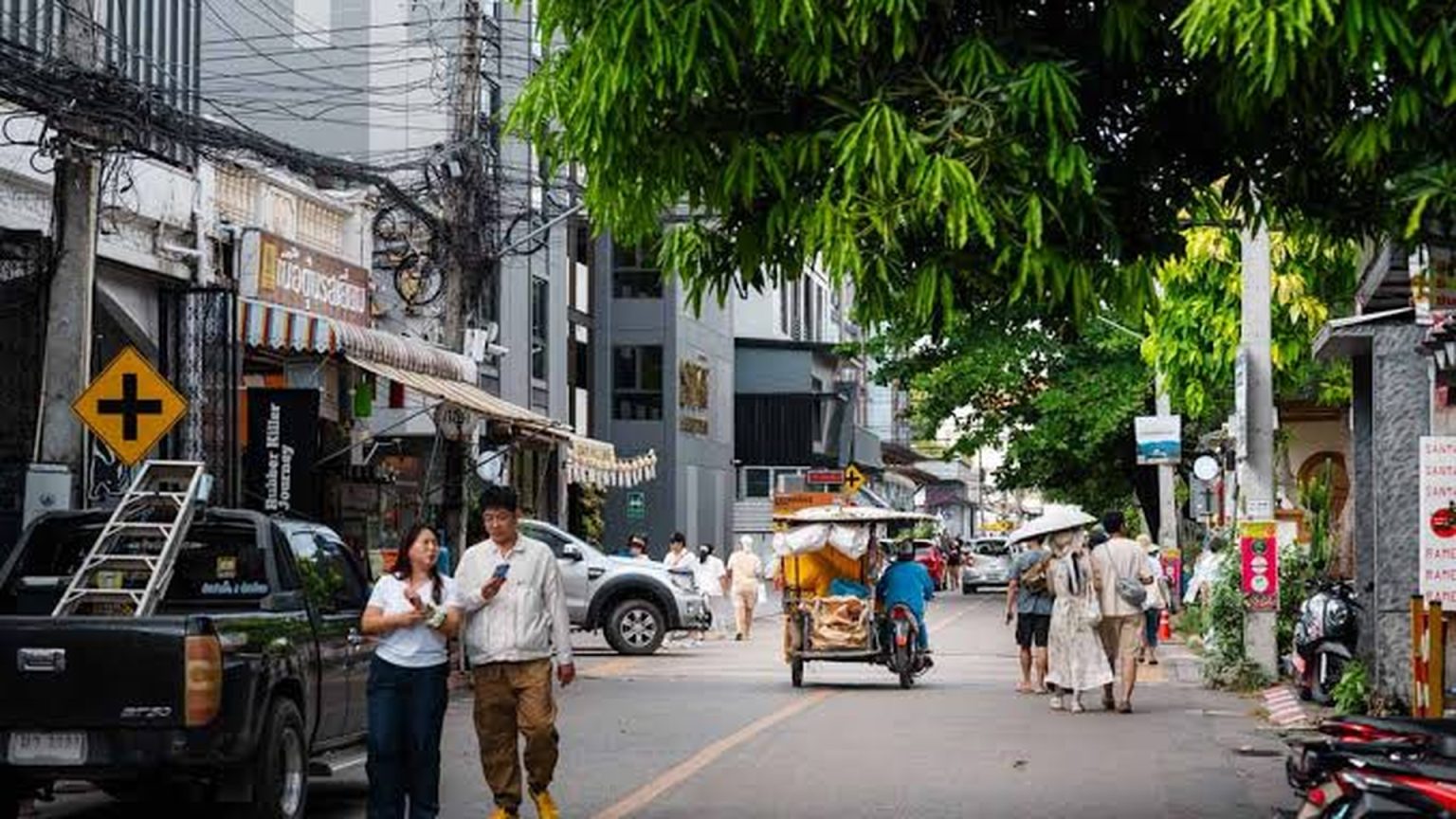
For more than a decade, Nimmanhaemin Road (Nimman) in Chiang Mai, Thailand has reigned as the undisputed global capital of the remote work revolution. With its dense cluster of artisan third-wave espresso bars, fiber-optic coworking hubs, boutique serviced condominiums, and sleek shopping complexes, it served as the quintessential soft-landing pad for freelance software engineers, content creators, and online entrepreneurs from around the globe.
1. Executive Summary & The Great Chiang Mai Neighborhood Migration
However, entering 2026, a structural transformation is sweeping through the northern Lanna capital’s expatriate ecosystem. Soaring rental rates, crowded cafes, aircraft flight-path noise, and rising commercialization in Nimman have triggered a significant migration just 10 minutes east into Santitham—a vibrant, authentic Thai-expat enclave often described as “the real Chiang Mai with 500 Mbps fiber.”
Coupled with Thailand’s landmark Destination Thailand Visa (DTV) managed by the Official Thailand Electronic Visa Portal, remote workers are no longer transient tourists doing border runs every 60 days; they are settling into 180-day to 5-year residencies. This comprehensive guide breaks down the real mathematical costs, neighborhood trade-offs, workspace realities, and seasonal survival strategies required to thrive in Chiang Mai on a realistic $950 to $1,800 monthly budget.
Key Takeaways for Remote Workers in Chiang Mai (2026)
- The Santitham Price Advantage: Modern studio condos in Santitham average 7,500 to 11,000 THB ($215–$315 USD) per month—roughly 40% to 50% cheaper than equivalent units in Nimman.
- DTV Visa Game-Changer: The 5-year Destination Thailand Visa allows 180-day stays per entry (extendable once in-country for 1,900 THB), completely legitimizing remote work for foreign clients.
- True Monthly Cost of Living: A comfortable, high-quality digital nomad lifestyle ranges from 33,000 THB ($940 USD) in Santitham to 58,000 THB ($1,650 USD) in premium Nimman developments.
- Smoky Season Awareness: Tracking PM2.5 levels from February through April via the official Air4Thai Pollution Control Network is non-negotiable for health planning.
2. Neighborhood Showdown: Nimman vs. Santitham vs. Old City vs. Wat Ket
Choosing the right neighborhood in Chiang Mai defines your daily routine, social network, and monthly burn rate. Here is an honest, firsthand evaluation of the four primary living hubs:
Nimmanhaemin (Nimman): The Convenient Expat Bubble
Bordered by Huay Kaew Road to the north and Suthep Road to the south, Nimman is tailored for frictionless modern living. You are never more than 90 seconds away from a specialty oat-milk flat white (Roast8ry Lab, Graph One Nimman), a 24-hour coworking lounge, or a Michelin Bib Gourmand eatery (Khao Soi Mae Sai on Soi Ratchaphruk). However, popularity comes at a cost: traffic on Soi 5, 7, and 9 can be chaotic, studio rentals routinely exceed 16,000 THB ($455 USD), and international airliners descending into Chiang Mai International Airport roar overhead every 15 minutes.
Santitham: The Authentic, Low-Cost Nomad Epicenter
Situated directly between Nimman and the Old City’s northwest corner, Santitham revolves around the iconic Santitham Roundabout and Thanin Market (Siriwattana Market). It offers an irresistible blend: tree-lined residential alleys filled with traditional Thai noodle stalls where a steaming bowl of Khao Man Gai costs 45 THB ($1.30 USD), sitting right next to specialty pour-over cafes (Akha Ama Coffee, Artisan Cafe) and modern high-speed coworking facilities. In Santitham, you get quiet nights, authentic neighborhood warmth, and luxury condos at half the price of Nimman.
The Old City: Historical Charm & Walkability
Enclosed by 700-year-old brick fortress walls and ancient moats, the Old City is ideal for history enthusiasts, yogis, and walkers. While vibrant around Sunday Walking Street and Tha Phae Gate, residential options consist largely of boutique guesthouses and converted townhomes rather than modern high-rise condos with gym and pool amenities.
Wat Ket & Riverside: Tranquility and Creative Cafes
Located on the eastern bank of the Ping River along Chiangmai-Lamphun Road, Wat Ket offers colonial heritage estates, peaceful riverfront dining, and lush botanical gardens. It caters to established expats, creative writers, and digital nomads seeking serenity away from nightlife strips.
3. Comprehensive Monthly Cost of Living Matrix (2026 Breakdown)
| Expense Category | Santitham (Value / Balanced) | Nimman (Modern / Hipster) | Old City (Heritage / Walkable) | Wat Ket (Riverside / Tranquil) |
|---|---|---|---|---|
| Modern Studio / 1-BR Condo | 8,500 THB ($242 USD) | 16,500 THB ($471 USD) | 11,000 THB ($314 USD) | 14,000 THB ($400 USD) |
| Electricity & Water Utilities | 1,800 THB ($51 USD) | 2,400 THB ($68 USD) | 2,000 THB ($57 USD) | 2,200 THB ($63 USD) |
| Fiber Internet & 5G Unlimited SIM | 900 THB ($26 USD) | 900 THB ($26 USD) | 900 THB ($26 USD) | 900 THB ($26 USD) |
| Coworking Space Membership | 3,200 THB ($91 USD) | 4,500 THB ($128 USD) | 3,500 THB ($100 USD) | 3,000 THB ($86 USD) |
| Food & Dining (Street + Cafes) | 9,500 THB ($271 USD) | 16,000 THB ($457 USD) | 12,500 THB ($357 USD) | 14,000 THB ($400 USD) |
| Transportation (Scooter Rental / Grab) | 3,200 THB ($91 USD) | 2,500 THB ($71 USD) | 2,800 THB ($80 USD) | 3,800 THB ($108 USD) |
| Health Insurance & Fitness / Gym | 3,500 THB ($100 USD) | 4,500 THB ($128 USD) | 3,500 THB ($100 USD) | 3,500 THB ($100 USD) |
| Entertainment & Weekend Trips | 3,000 THB ($86 USD) | 6,500 THB ($186 USD) | 4,500 THB ($128 USD) | 5,000 THB ($143 USD) |
| ESTIMATED TOTAL MONTHLY BUDGET | 34,600 THB (~$988 USD) | 53,800 THB (~$1,537 USD) | 41,700 THB (~$1,191 USD) | 47,400 THB (~$1,354 USD) |
4. Workspace Infrastructure: Top Coworking Spaces & Work Cafes
Reliable high-speed connectivity, ergonomic seating, and silent call booths are critical for remote productivity. Chiang Mai boasts some of the world’s highest internet speeds, with standard residential fiber delivering 500 to 1,000 Mbps symmetrical bandwidth.
| Workspace Venue | Neighborhood Location | Average WiFi Speed (Down/Up) | Pricing (Day Pass / Monthly) | Ergonomics & Standout Features |
|---|---|---|---|---|
| Yellow Coworking | Nimman (Soi 9) | 650 Mbps / 500 Mbps | 390 THB / 4,800 THB | Dedicated podcast studio, Skype booths, ergonomic Herman Miller chairs, ice baths. |
| Heartwork the Sharing Space | Chang Moi / Old City East | 450 Mbps / 400 Mbps | 180 THB / 2,800 THB | Quiet minimalist design, community art gallery, natural sunlight, specialty matcha. |
| Punspace Wiang Kaew | Old City North | 500 Mbps / 450 Mbps | 290 THB / 3,800 THB | Set in a tranquil courtyard courtyard, private meeting rooms, 24/7 keycard access. |
| CAMP @ MAYA Mall | Nimman / Huay Kaew | 300 Mbps / 250 Mbps | Free with coffee purchase | 24-hour open floor plan, spacious tables, direct access to cinema and food court. |
| Akha Ama Phrasingh | Old City West | 250 Mbps / 200 Mbps | Cafe purchase (~80 THB) | Award-winning single-origin Lanna highland coffee, shaded outdoor garden seating. |
5. Visa Navigation in 2026: The Destination Thailand Visa (DTV)
The regulatory landscape for remote workers in Thailand was revolutionized with the introduction of the Destination Thailand Visa (DTV):
- 5-Year Multiple Entry Validity: Allows digital nomads, freelancers, and remote company employees to reside in Thailand legally for up to 180 days per entry.
- In-Country Extension: Each 180-day stay can be extended once at the Chiang Mai Provincial Immigration Office for an additional 180 days upon payment of the standard 1,900 THB fee.
- Core Financial Requirements: Applicants must demonstrate proof of funds of at least 500,000 THB ($14,200 USD) and provide an active employment contract or professional portfolio demonstrating remote work with non-Thai corporate clients.
- Tax Status: Income earned from foreign clients during remote work stays is generally exempt from Thai domestic personal income taxation provided funds are not remitted into Thailand within the same tax assessment year.
6. Seasonal Realities: Surviving Chiang Mai’s Smoky Season
No honest guide to Chiang Mai is complete without addressing Smoky Season (Burning Season), which typically spans from mid-February through mid-April:
- Agricultural Burning Dynamics: Trapped mountain valley topography combines with regional post-harvest crop clearing and forest fires across Northern Thailand, Laos, and Myanmar, causing airborne PM2.5 levels to spike significantly.
- Daily Monitoring with Air4Thai: Remote workers should download the official Air4Thai Environmental Monitoring App to track real-time air quality index (AQI) readings across urban Chiang Mai sensor stations.
- Survival Strategy (The Annual Expat Shift): Experienced digital nomads invest in room air purifiers (Xiaomi Air Purifier 4 series) or use February–April to travel south to the Thai islands (Koh Samui, Koh Phangan, Krabi) or work from Da Nang, Vietnam, returning to Chiang Mai when monsoon rains clear the skies in May.
7. Actionable Step-by-Step Relocation Checklist
To execute a seamless transition to Chiang Mai:
- Secure Your DTV Visa Before Arrival: Apply 3 to 4 weeks in advance via the official e-Visa portal to avoid tourist visa extension hassles.
- Book 5 Days in Temporary Accommodation: Reserve an initial stay in Santitham or Nimman, rent an automatic scooter (Honda Click 125cc for ~3,000 THB/month), and physically tour condo buildings in person to negotiate 6-month or 1-year lease rates directly with building managers.
- Get an International Driving Permit (IDP): Ensure your home motorcycle license carries an official IDP stamp to comply with local traffic checkpoints along the Chiang Mai Superhighway and Canal Road.
- Set Up Local Banking & PromptPay: Open a Thai bank account (Bangkok Bank or Kasikornbank) with your long-term visa to access QR-code PromptPay mobile payments, accepted universally from street fruit carts to upscale supermarkets.
Conclusion
Chiang Mai’s magnetic appeal lies in its unmatched balance of hyper-modern digital infrastructure and deep cultural soul. Whether you choose the bustling, stylish streets of Nimman or the tranquil, cost-effective culinary alleys of Santitham, Northern Thailand remains one of the world’s premier destinations for building a fulfilling, sustainable, and productive location-independent life.