

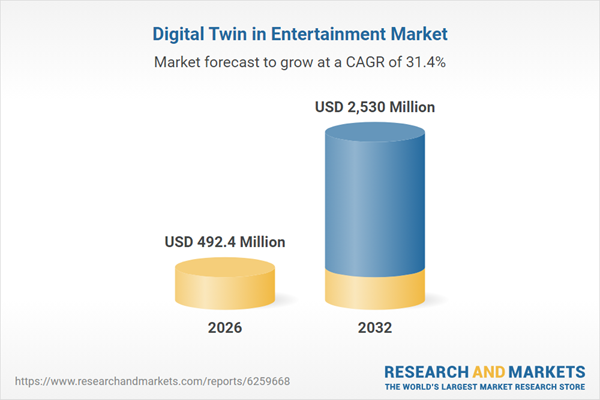
The convergence of real-time 3D rendering engines, generative artificial intelligence, and extended reality (XR) is fundamentally revolutionizing Hollywood filmmaking, live stadium concerts, and spatial computing. According to a landmark market intelligence report released by Research and Markets and distributed via GlobeNewswire, the global digital twin in entertainment market is projected to expand from $492.4 million in 2026 to an astonishing $2.53 billion by 2032.
This meteoric expansion represents a compound annual growth rate (CAGR) of 31.4% over the six-year forecast horizon. The research underscores that major entertainment studios, streaming broadcasters, and theme park operators are moving beyond traditional computer-generated imagery (CGI) toward persistent, real-time digital twins—virtual replicas of physical actors, studio soundstages, historical heritage sites, and massive stadium concert venues as tracked by Mashable Entertainment.
Key Takeaways from the Digital Twin Entertainment Report
- Market Quintupling by 2032: Scaling from $492.4 million in 2026 to $2.53 billion by 2032 at a 31.4% CAGR.
- Dominance of Real-Time Virtual Production: LED soundstages powered by game engines like Unreal Engine reduce on-location production costs by up to 45%.
- Commercialization of AI Digital Humans: Contractual digital likeness twins enable automated multilingual dubbing, youth de-aging, and posthumous archival performances.
- Interactive Stadium & Theme Park Spatial Twins: High-fidelity digital replicas allow remote global fans to attend live sports and concerts in spatial reality headsets.
Deep Dive: Core Technology Drivers Behind the 31.4% CAGR Surge
Unlike conventional static 3D animation, a digital twin is an active, data-driven simulation that mirrors physical environmental lighting, camera optics, and performer biomechanics in real time. Three core technological breakthroughs are fueling this explosive commercial adoption:
- In-Camera Visual Effects (ICVFX) on LED Volumes: Productions utilize dynamic LED backdrops that calculate parallax in real time relative to camera positioning. This eliminates green-screen spill and allows directors, actors, and cinematographers to see photorealistic final environments live on set.
- Neural Radiance Fields (NeRFs) and 3D Gaussian Splatting: Production crews can capture complex real-world physical environments with handheld camera rigs and generate fully navigable, photorealistic digital sets within hours.
- Real-Time Performance Capture and Facial Rigging: AI motion-tracking algorithms capture micro-expressions and pupil dilation without requiring intrusive physical marker dots, streamlining the creation of digital doubles.
“Digital twins represent the ultimate bridge between physical cinema and interactive spatial computing. By creating living, persistent virtual replicas of soundstages, sets, and performers, studios can shoot a feature film, deploy an interactive video game, and host a live VR theme park experience from a single unified asset pipeline.”
Digital Twin in Entertainment Market Segmentation & Growth Matrix
| Application Sector | 2026 Estimated Market Size | 2032 Projected Valuation | Key Technological Enablers & Strategic Value |
|---|---|---|---|
| Virtual Film & TV Production | $195.2 Million | $980.5 Million | LED soundstages, real-time camera tracking, automated daylight simulation. |
| Digital Humans & Likeness Rights | $142.6 Million | $765.4 Million | Neural facial rigging, automated vocal cloning, SAG-AFTRA compliant contracts. |
| Virtual Concerts & Live Stadium Events | $88.4 Million | $475.2 Million | Volumetric capture arrays, spatial audio feeds, multi-platform VR streaming. |
| Theme Parks & Spatial Attractions | $66.2 Million | $308.9 Million | BIM facility twinning, augmented reality crowd navigation, ride simulation. |
Studio Economics: Eliminating On-Location Overhead and Post-Production Delays
The economic justification for studio executives adopting digital twin workflows centers on risk reduction and production agility:
- Slashing Location Scouting and Travel Budgets: Rather than flying 200-person film crews across international borders, visual effects teams send small volumetric scanning units to digitize exotic locations into high-resolution virtual assets.
- Weather and Lighting Independence: “Golden hour” sunset lighting can be locked indefinitely on an LED volume stage, allowing directors to shoot complex daylight scenes for 12 continuous hours without resetting equipment.
- Accelerated Post-Production Turnaround: Because up to 70% of visual effects are captured in-camera during principal photography, post-production editing schedules are compressed from 18 months down to 6 months.
Ethical, Legal, and SAG-AFTRA Compliance Frameworks
The proliferation of digital actor replicas has placed legal consent and likeness rights at the forefront of Hollywood labor agreements:
- Mandatory Explicit Digital Consent: Under updated collective bargaining agreements, studios must obtain clear, separate written authorizations defining the exact duration, scope, and script parameters for which a performer’s digital twin may be deployed.
- Mandatory Likeness Compensation: Performers receive standardized day-rate residuals and digital likeness royalties whenever their scanned 3D double is utilized in secondary background shots or digital spin-offs.
- Deepfake Provenance Watermarking: Industry-standard cryptographic watermarking is embedded directly into digital twin rendering engines to distinguish authorized studio assets from unapproved synthetic media.
Regional Market Expansion Dynamics
Geographic market share reflects differing global production priorities:
- North America (Leading Market Share ~42%): Dominates virtual studio buildouts in Los Angeles, Atlanta, and Vancouver driven by major streaming platforms (Disney+, Netflix, Amazon MGM).
- Europe (Fast-Growing Hub ~28%): Rapidly expanding virtual production hubs across London (Pinewood Studios), Germany (Babelsberg), and Spain, supported by lucrative government tax rebates.
- Asia-Pacific (Highest CAGR ~35.2%): Accelerating adoption across South Korea, Japan, and India, where K-Pop virtual idols, anime avatars, and Bollywood spectacle cinema embrace digital human workflows.
Actionable Playbook for Filmmakers, Studio Heads, and VFX Supervisors
For independent directors, production executives, and VFX supervisors seeking to integrate digital twins into upcoming slates:
- Build a Centralized Asset Library from Day One: Ensure all physical set builds, props, and location scans are archived as universal USD (Universal Scene Description) assets for multi-project reusability.
- Conduct Comprehensive Pre-Visualization (Previs) in Engine: Block camera angles, lighting conditions, and actor marks inside a real-time virtual engine prior to entering the soundstage to maximize physical shooting efficiency.
- Partner with Certified Likeness Trust Platforms: Implement secure, encrypted digital identity vaults to safeguard actor scans against unauthorized leaks and IP infringement.
Conclusion
The projected expansion of the digital twin in entertainment market to $2.53 billion by 2032 signals the dawn of a new era in entertainment production. By fusing photorealistic physical accuracy with limitless digital creativity, digital twins are establishing the foundation for the next century of cinematic storytelling and immersive media.